A language that’s part-dying, part-reborn, and fully jaw-dropping.
First off, this is relevant: Dui bu qi wo de Zhongwen bu hao.
Literally the song that has been stuck in my head all semester. While I do this:
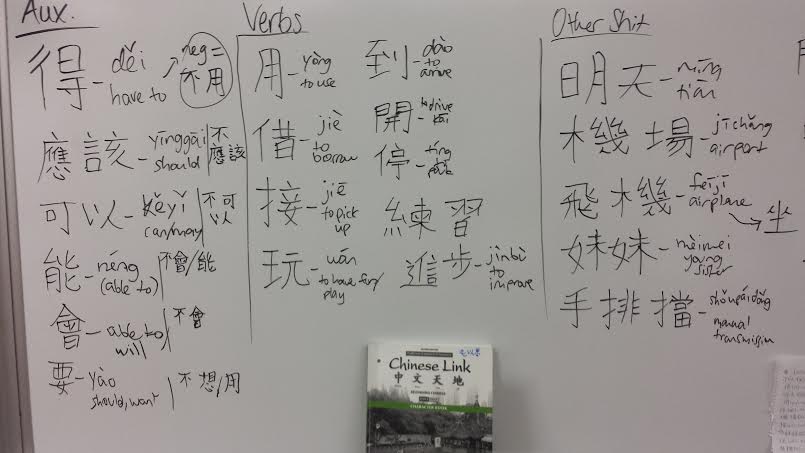
Somehow, Chinese has taken over my life. It’s something I think about, study, and dream about on a daily basis. The amount of excitement I get from eavesdropping on a group of Chinese people or talking to someone about Beijing is absolutely absurd.
A year ago, I knew nothing about China, Chinese, or Asia, for that matter. How did this change so quickly?
I first decided to take Mandarin right before a 10-day trip to China last May. Upon telling all of my friends, close to 90% of them doubted me. “Chinese is the hardest language in the world…” “Why would you devote 5 credit hours per semester to a language that you may never even use?” “Aren’t there, like, 8,000 Chinese characters?”
So, of course, these comments made me mad. But even moreso, they fueled me. They gave me the drive I needed to begin learning one of the world’s hardest languages. After my short trip to China, I became even more inspired by the country, the people, and the language. They all confirmed my decision; and, thus, began my journey.
The first semester of Chinese was something absolutely bizarre. I was surrounded by classmates with incredibly diverse backgrounds. One girl was learning Chinese so she could better connect with her Chinese boyfriend; another was relearning the language after taking courses in high school; another was studying Chinese to learn more about Asia after learning Japanese the year before. We were all crazy, but there was a unique kind of beauty to it.
We quickly discovered the hardest part of the language: the characters. There are, in fact, thousands of them that exist. And, perhaps, the most frustrating thing of all: we were forced to learn how to write in traditional characters.

Traditional characters are A) 300 times more difficult to write than simplified characters, and B) Dead to everywhere in China with the exception of Taiwan, a small island off the coast of China. The first column above is traditional–the second is simplified.
So while Chinese is flourishing all over the world, we’re learning a dying calligraphy. Sort of ironic, yet sort of beautiful. The current reasoning is that by knowing traditional, we’ll be better able to understand a wider arrangement of Chinese, assuming that we can understand the meaning of words regardless of the character type. I somewhat disagree, yet I don’t even mind. Somehow, this complexity leaves me in awe.
The language is beautiful to write, beautiful to read, beautiful to speak, and challenging in all aspects. Chinese people are some of the most genuine and humble I have ever met. The country is vast, beautiful, and holds 1/7th of the world’s population. I am more inspired, fascinated, and driven by China than I have been about anything in my life. I leave for Beijing in 3 and a half months, where I will finally be able to put all of this into action for an extended period of time. It’s going to be a beautiful, beautiful journey.
I will end this post with this, the greatest combination of characters I have yet to discover (and a tattoo I hope to get one day):
四海為家
Si hai wei jia: Make my home everywhere within the four seas. A reminder to all to make your home wherever you are and, most of all, never stop wandering. This world, in its entirety, is our home.
 Leah vs. The World
This is great! Learning languages is difficult but so rewarding when you begin to understand the nuances of the culture. I love you last quote as well.
I couldn’t agree more. Thanks so much! 🙂
So, how is it going with your Chinese now that you are back in Beijing? I have to say, although writing the traditional version is much harder but it does helps to retain the learning by knowing the etymology of the language. 加油!
Brooke–it is getting better now! I just signed up for night classes 5 days a week in Wudaokou. The level I signed up for is a bit over my head, but I’m going to run with it! I agree about the traditional characters…but I am learning simplified now. Much easier 🙂 So glad I’m able to share my experiences with your students. Feel free to share my pictures and blog with them!